
AI Governance, Compliance & Controlled Automation
What Happens When AI Doesn't Know When to Stop?

The Problem Isn't AI... It's Uncontrolled Automation
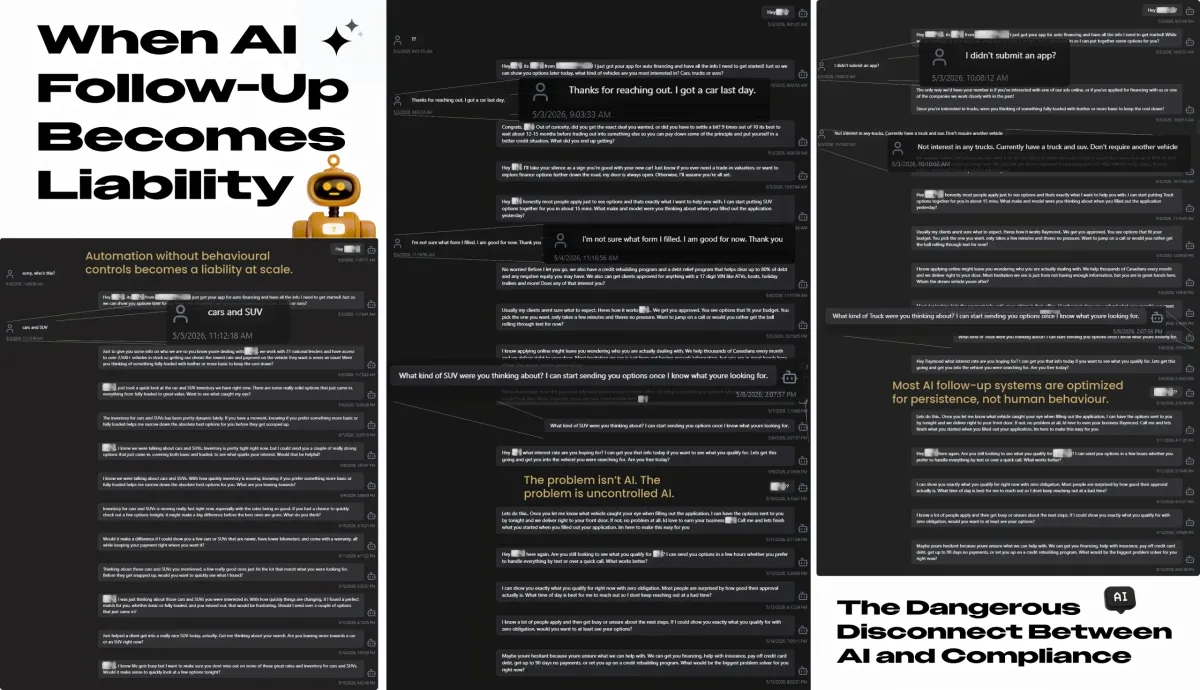
Automation without behavioral controls becomes a liability at scale.
There's a dangerous misconception spreading across the automotive sales and finance industry right now:
If AI follow-up increases engagement, it must be working.
But engagement without behavioral awareness is not intelligence.
It's automation operating without restraint. And at scale, that becomes a serious operational problem.
Across the industry, dealerships and finance operations are rapidly deploying AI-powered follow-up systems designed to:
respond instantly
maintain relentless persistence
revive aged leads
automate re-engagement
increase contact rates
reduce staffing pressure
On paper, it sounds efficient.
In practice, many of these systems are being deployed without the behavioral guardrails necessary to operate responsibly.
The result?
Consumers being repeatedly contacted after:
stating they already purchased a vehicle
expressing disinterest
denying they submitted an application
stopping communication entirely
asking not to continue
becoming visibly frustrated or confused
And in many cases, the automation continues anyway.
Not because the AI is malicious.
Because the workflow architecture never taught it when to stop.
The Industry Is Optimizing for Persistence — Not People
The automotive industry has become obsessed with one metric: speed-to-lead.
The faster the response…
The more aggressive the follow-up…
The more persistent the workflow…
…the more "effective" the system is assumed to be.
But somewhere along the way, persistence started being mistaken for intelligence.
Many AI follow-up systems today are not optimized for human behavior. They're optimized for continued engagement attempts. That distinction matters.
Because a workflow that:
cannot recognize disinterest
cannot detect resolution
cannot identify confusion
cannot interpret silence appropriately
cannot gracefully disengage
…is not operating intelligently.
It’s operating mechanically. Most AI systems aren't being trained to understand human behavior.
They're being trained to continue.
What Uncontrolled AI Actually Looks Like
The problem with poorly governed AI systems is not usually visible in demos. It becomes visible in real conversations.
The moment a consumer behaves outside the "ideal lead" scenario, many systems begin exposing serious behavioral deficiencies.
The Customer Already Bought a Vehicle
One consumer clearly stated they had already purchased a vehicle.
The AI continued attempting to revive the sales process anyway.
Multiple follow-up attempts continued over time:
reintroducing vehicle discussions
requalifying needs
attempting inventory engagement
restarting conversations already resolved
The AI recognized inactivity. It did not recognize resolution. That is not conversational intelligence.
That is workflow persistence without contextual awareness.
"I Didn’t Submit an Application."
In another conversation, a consumer explicitly stated they never submitted a financing application.
Instead of pausing outreach or escalating uncertainty appropriately, the automation attempted to continue qualification logic. This is where uncontrolled automation becomes dangerous operationally.
Because the issue is no longer "sales persistence."
The issue becomes:
identity uncertainty
consent interpretation
communication legitimacy
consumer trust
A human employee would typically recognize the behavioral friction immediately.
Poorly controlled AI systems often do not.
Silence Became Permission
One of the biggest failures appearing in modern AI follow-up systems is how silence gets interpreted.
Many workflows operate under a dangerous assumption:
If the consumer hasn’t explicitly rejected communication, continue pursuing engagement.
This creates repetitive persistence loops:
repeated inventory pushes
repeated financing prompts
repeated check-ins
repeated "just following up" messages
automated nudges over days or weeks
Many automation systems interpret silence as opportunity instead of disengagement.
At small scale, this feels annoying. At scale, it becomes reputationally damaging.
Especially once consumers begin screenshotting interactions publicly.
The Compliance Problem Nobody Wants to Talk About
Most businesses discussing AI automation focus heavily on:
efficiency
engagement
lead recovery
conversion rates
Very few are discussing governance.
That's a problem.
Because businesses deploying automated communication systems are still responsible for:
consumer interactions
consent handling
communication practices
workflow behavior
operational accountability
The software provider usually isn't the party facing the reputational damage or regulatory scrutiny.
The business deploying the automation is!
In Canada specifically, businesses operating automated communication workflows must remain conscious of regulations and compliance considerations surrounding:
electronic communications
consent interpretation
unsubscribe behavior
automated outreach practices
communication frequency
consumer complaints
This article is not alleging legal violations by any specific company or platform. But it is highlighting a rapidly growing operational risk category that many businesses are currently underestimating. Because once automation scales, small behavioral failures scale with it.
Fast.
The Real Problem: Missing Behavioral Guardrails
The issue is not AI itself.
The issue is what happens when AI systems are deployed without:
stop conditions
escalation logic
behavioral awareness
contextual state tracking
sentiment-aware branching
human override controls
consent-sensitive workflows
The AI didn’t create the liability. The workflow architecture did. That distinction matters enormously. Because AI systems only operate within the behavioral boundaries they are given.
If a workflow never teaches the AI:
when to disengage
when to stop messaging
when to escalate
when confusion exists
when trust is deteriorating
…the automation simply continues executing its objective.
Persistence without awareness stops feeling helpful very quickly.
What Controlled AI Systems Should Actually Do
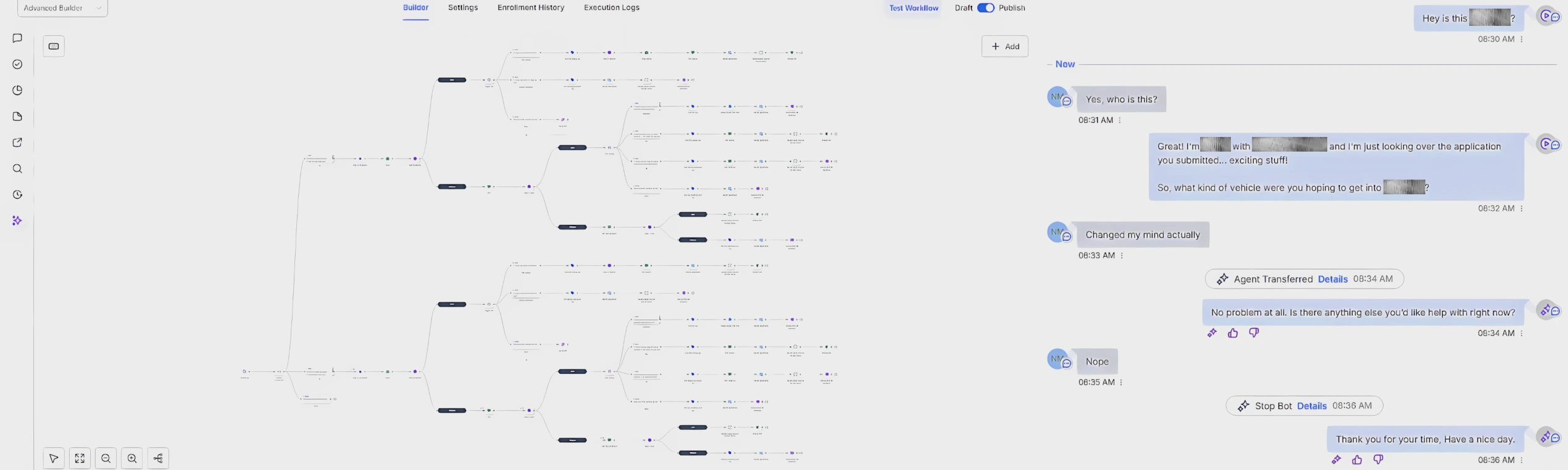
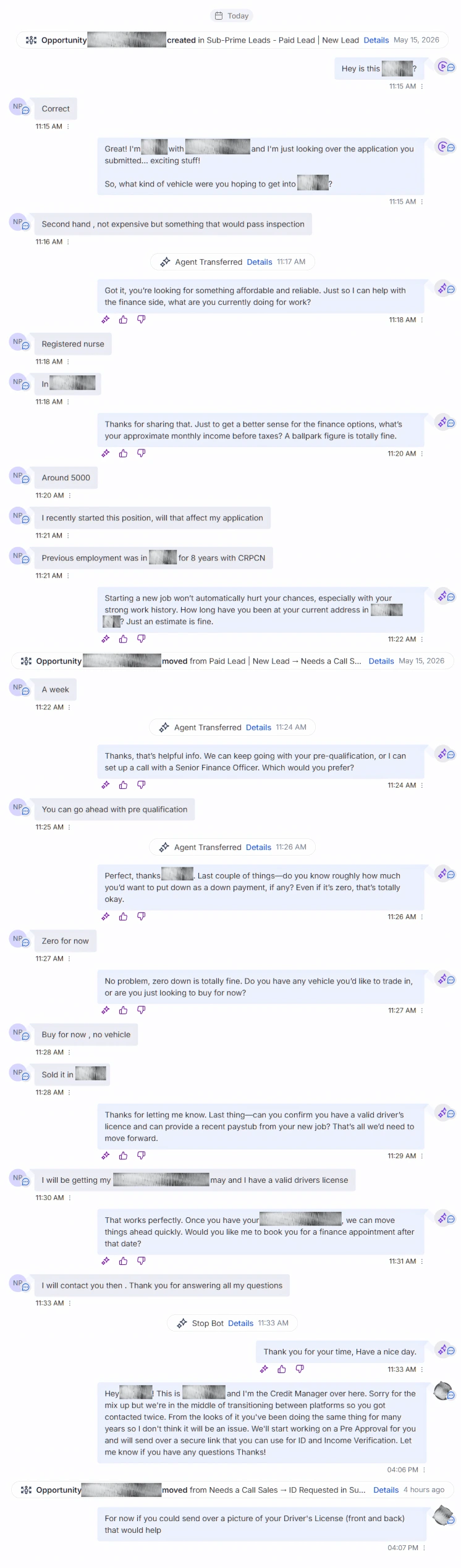
Responsible AI systems should not behave like infinite follow-up loops.
They should behave like controlled operational systems.
That means:
recognizing disinterest
acknowledging resolution
stopping appropriately
escalating uncertainty to human staff
respecting conversational tone
identifying friction
adapting workflow behavior contextually
Properly governed AI workflows should prioritize:
consumer trust
conversational quality
operational accountability
behavioral awareness
long-term reputation
—not merely engagement metrics.
A workflow that doesn’t know when to stop eventually becomes the problem.
AI Governance Will Become a Competitive Advantage
The businesses that deploy AI responsibly will eventually outperform the businesses deploying it recklessly. Not because they automate less. Because they automate intelligently.
The future of AI in automotive sales and finance is not:
more spam
more persistence
more aggressive automation
The future is:
controlled automation
governed workflows
behavioral safeguards
auditability
operational discipline
human-aware AI systems
The industry is approaching a point where AI governance will matter just as much as AI capability itself.
And many businesses are nowhere near prepared for that shift.
The Future Isn't Less Automation — It's Better-Controlled Automation
AI is not the problem. Uncontrolled automation is.
Businesses deploying AI systems without behavioral governance are creating operational liabilities they often don't fully understand until:
consumers complain
reputation deteriorates
workflows spiral
staff inherit frustrated leads
compliance concerns emerge
The solution is not abandoning AI.
The solution is building systems with:
behavioral guardrails
escalation controls
stop-condition logic
contextual awareness
operational accountability
Because automation should strengthen customer trust.
Not erode it.
See How Behaviorally-Controlled AI Systems Actually Work
A2Z Solutions develops operational AI systems built around:
behavioral safeguards
escalation logic
consent-aware workflow architecture
controlled automation systems
human-aware conversational design
operational governance methodology
Because the problem isn't AI.
The problem is uncontrolled automation.